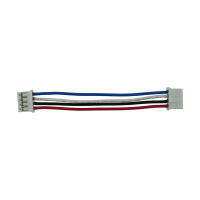
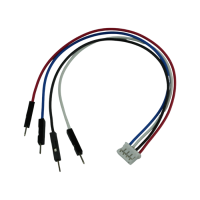
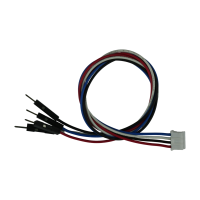
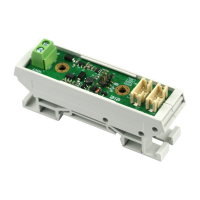
*The RoHS icon on this product indicates that the PCBs, components, solder, and chemicals are all lead-free and RoHS compliant. Additionally, this product is produced using a lead-free process. Unfortunately, we are currently unable to provide documentation confirming that this product is RoHS compliant.
Resources:
*If your browser cannot display the PDF file properly, please save it to your computer and open it with a PDF reader.
Package Includes:
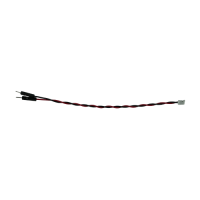
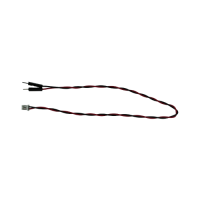
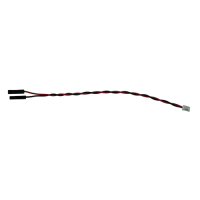
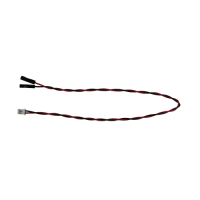
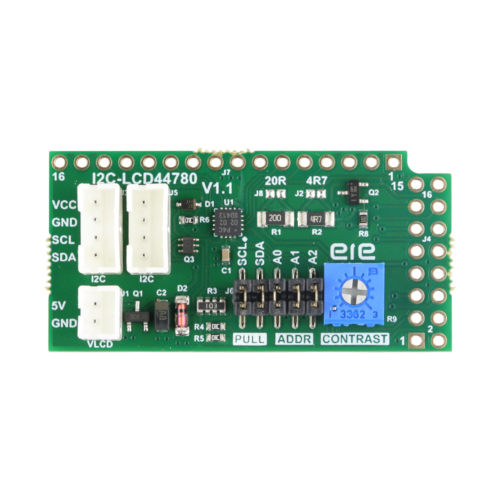 This package doesn't include connectors and cables.
Notes:
This package doesn't include connectors and cables.
Notes:
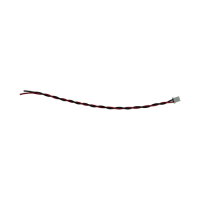
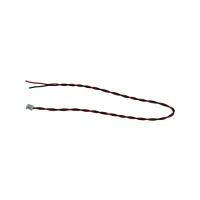
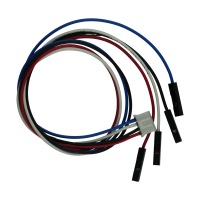
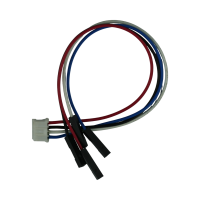
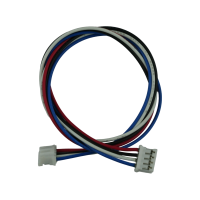
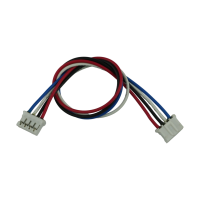
- This board uses 4-pin (pin-pitch:2.00mm) connectors for I2C bus.
Features:
- Control LCD modules via a standard I2C bus
- Powered by PCA9554B and PCA9554C chips
- Supports reading the BUSY bit from LCD modules
- High-speed I2C communication up to 400kHz. (Fast mode)
- Onboard adjustable I2C bus pull-up resistors
- Easy addressing via 3-pin jumpers
- Operates from 2.3V to 5.5V (I2C) and 3V to 5.5V (LCD)
- Built-in circuit protection against wiring errors
- Integrated potentiometer for LCD contrast adjustment
- Software-controllable (ON/OFF) with current limiting
- Designed for installation on the back of the LCD panel
- Small footprint of only 23.00 x 46.00 mm
The I2C Bus LCD Module Controller Board is designed to interface with LCD modules using only two wires via the I2C bus. Available in two models—I2C-LCD44780B and I2C-LCD44780C—this controller supports LCD modules with operating voltages ranging from 3V to 5V. For hardware configuration, the board features three addressing pins, allowing for the selection of up to eight unique I2C addresses. It also includes built-in pull-up resistors for the SCL and SDA lines, an onboard potentiometer (POT) for precise contrast adjustment, and integrated resistors to limit the backlight current.
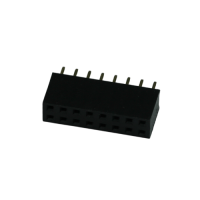
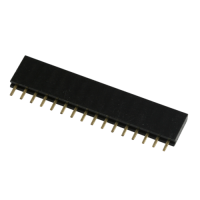
In terms of installation, the board is engineered to be mounted directly onto the back of an LCD module, connecting via either 16-pin or 2x8-pin connectors. Additionally, the controller provides a dedicated power connector for the LCD and allows for software-based ON/OFF control of the backlight.
To prevent damage to the board, do not plug or unplug I2C cables while the power supply is on. Always turn off the power supply before plugging or unplugging I2C cables on the board.